



Long forced to suppress its culture and history, the minority group is embracing its traumatic past while maintaining its allegiance to the state.
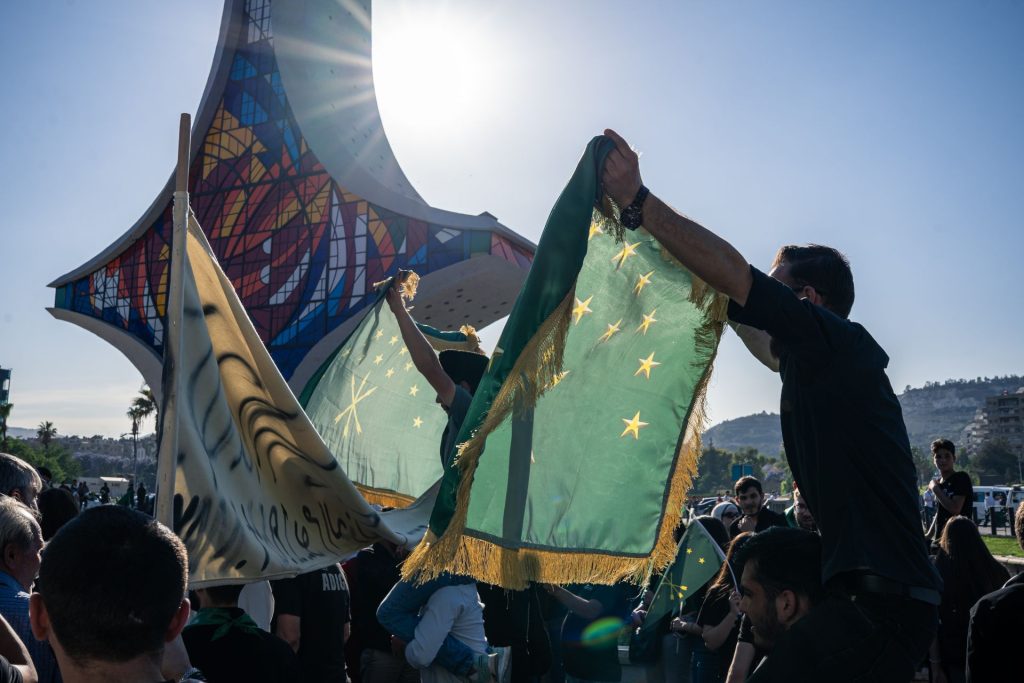
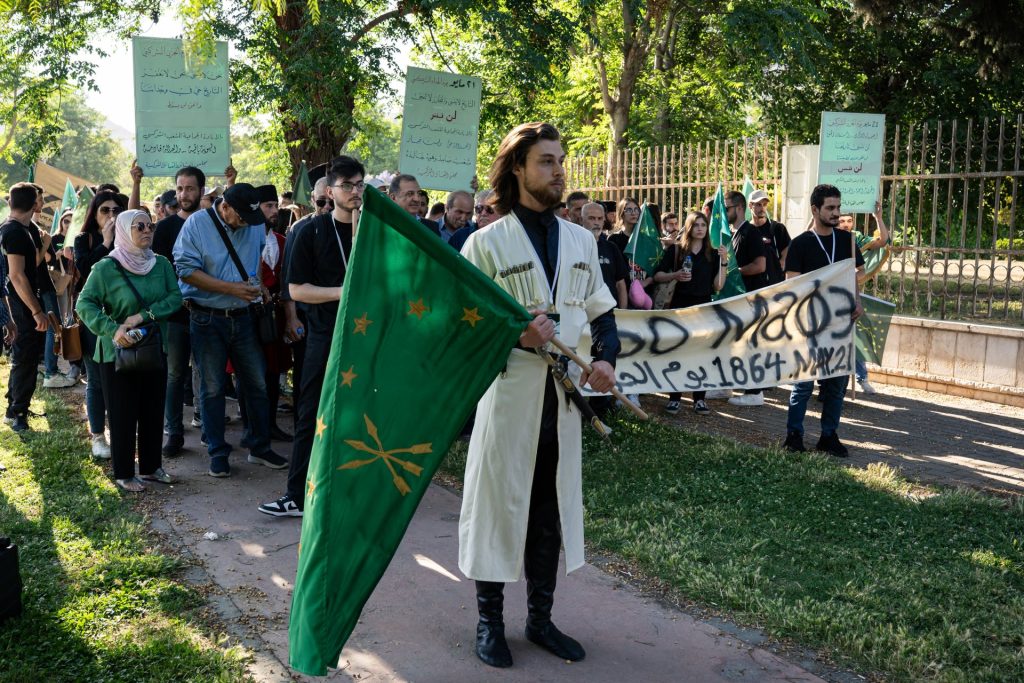
On May 21, 2025, under the blazing sun of a Damascus spring, a few hundred people gathered near Umayyad Square. The air shimmered with heat, yet several men at the head of the procession wore fur hats and heavy coats, a deliberate echo of their homeland, the Caucasus. Green banners rippled above the crowd, bearing the 12 golden stars and three arrows of the Circassian flag.
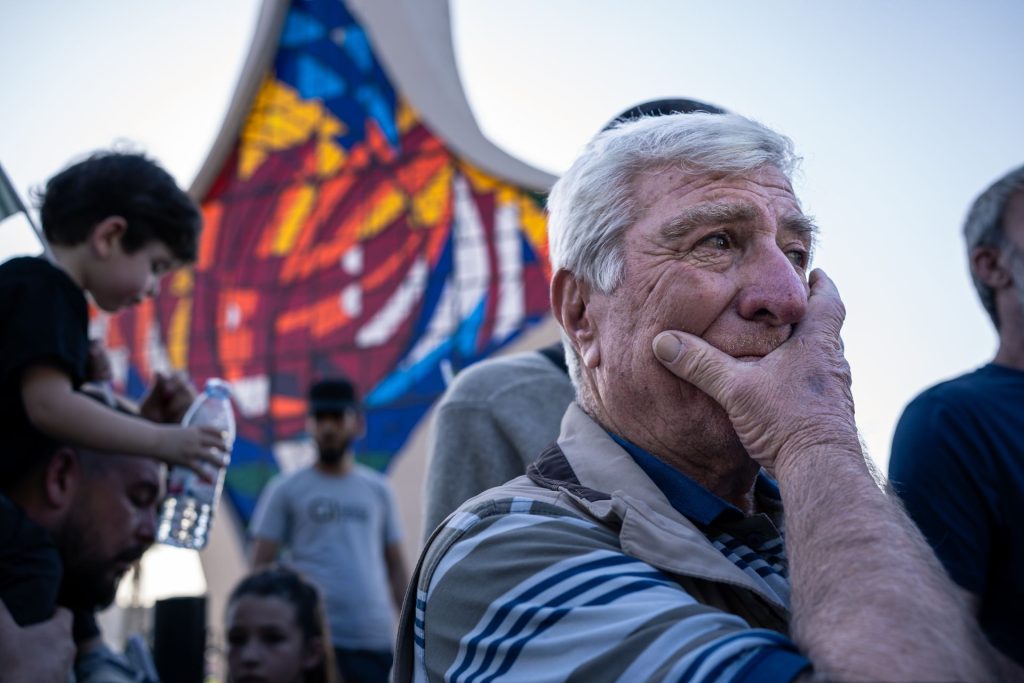
It was the first time in more than half a century that Syria’s Circassians were able to mark their Day of Mourning in public, commemorating the expulsion from their ancestral lands by tsarist Russia in 1864. For decades, Circassians’ own story of exile had been politically inconvenient in Syria, suppressed by the now-ousted, Russia-allied Assad regime. Now, as Syria redefines itself — and the country’s new government renegotiates its relationships with Russia and Israel, which also displaced Circassians — that silence has begun to lift, and multiple generations within the community are redefining what it means to be both Circassian and Syrian.
Earlier that morning, a bus departed from Marj al-Sultan, a Circassian-majority village on the outskirts of Damascus. The town’s name, which means “the Sultan’s meadow,” recalls its Ottoman roots: At the turn of the 19th century, Sultan Abdul Hamid II granted the land to 150 Circassian families fleeing Russian conquest. At the time, the Ottoman Empire relocated Circassian communities within its borderlands as a means of asserting control over populations who contested its rule, such as Bedouins and Druze. Many relocated Circassian communities found themselves in Syria’s Golan Heights, home to much of the country’s Druze population, or in the countryside of major cities like Damascus and Homs, where Bedouin tribes roamed.
Inside the bus, young men and women clapped to traditional Circassian music. On the way to the Umayyad Square, the mood was bright, almost festive. “I’m very proud to go to Damascus to commemorate our Day of Mourning, to show that we exist as a community and are not forgotten,” 23-year-old Bachar told New Lines, preferring to use only a first name. For him, the occasion was also a chance to share his family’s story. Once in Damascus, he unfurled his flag and joined the slow procession, looking solemn as he adapted to the mood.
Among the marchers was Mona, 57, who never thought she would commemorate such an event publicly, having lived most of her life in the shadows of the Assad regime. She was not yet confident enough to share her full name. “When I arrived at the square, my heart sank,” she said, tears welling up. “Even though I don’t personally know my ancestors who died, I felt the sadness and the weight of Russia’s crimes against our community.”
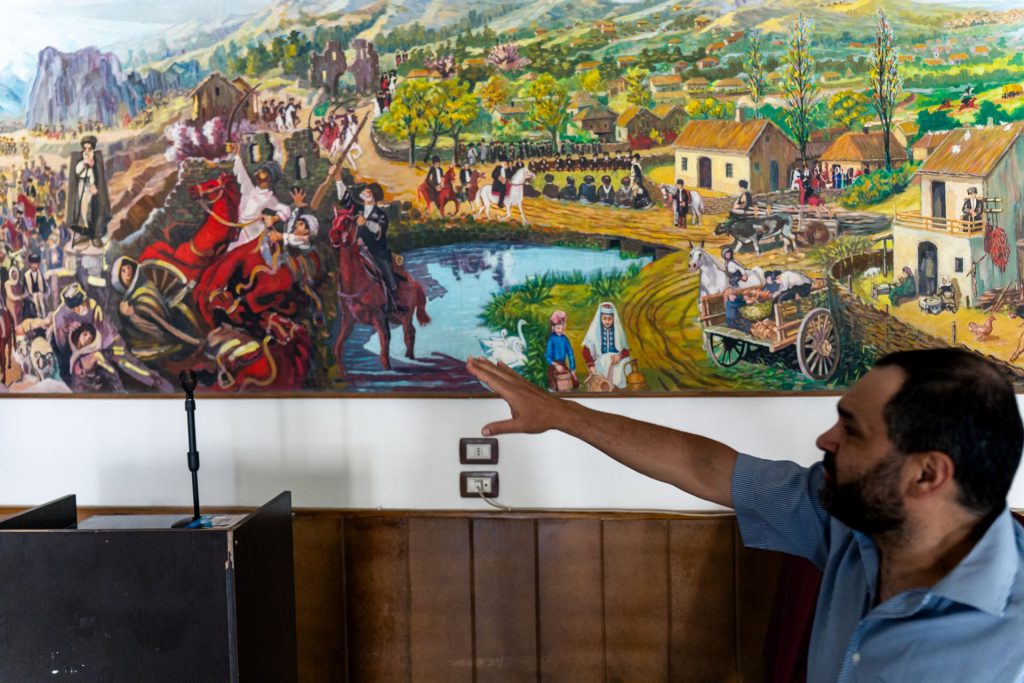
The Circassians’ story begins in the mountains of the northwestern Caucasus, north of modern-day Georgia, where they resisted tsarist imperial expansion for more than a century. When the Russian Empire finally subdued the region in 1864, it unleashed one of the 19th century’s most brutal mass expulsions. Entire villages were burned, and survivors were herded to the Black Sea coast, where tens of thousands perished while awaiting deportation to Ottoman lands.
Historians estimate that as many as 2 million Circassians were forced from their homeland, and nearly a quarter died along the way. Those who survived were scattered across the Ottoman Empire — to modern-day Turkey, Jordan and Syria. They built tightly knit communities, loyal to the states that hosted them yet carrying the pain of exile. Even now, some families refuse to eat fish from the Black Sea, a quiet tribute to those who drowned there during the crossings.
A century later, another displacement was visited upon the community. In 1967, during the Arab-Israeli war, Israel’s capture of the Golan Heights forced thousands of Syrian Circassians to flee once more. The towns and farms they had built on the plateau were abandoned overnight after Israeli troops expelled them.
Mazhar Abdallah has a piercing gaze, thin mustache and receding hairline. Today he lives in Marj al-Sultan, and remembers well the moment his life changed. He recalls fleeing his village of Khishniyeh in the Golan Heights with his family at the age of 5. “The Israelis ended my childhood that day, when they stole the land we lived on,” he said quietly. Although he dreams of the Caucasus, it is the Golan Heights, lush with its fig and apple trees, that he longs to see again. “If I could leave tomorrow, I would. But ambition is one thing, possibility another,” said Abdallah, now 60. He is not opposed to normalization with Israel, if it would allow him to return to the Golan and ensure that the region returns to Syrian control, though he made clear that he is not so optimistic about such prospects in his lifetime.
At the Circassian Charity Association branch in Damascus’ Rukn al-Din neighborhood, a map still labels the Golan Heights as part of Syria. Baybars Idaha, a regular at the center, traces his finger across it, pausing at the 14 Circassian villages that once dotted the plateau. “Of those 14,” he said, “only three remain,” lying within the buffer zone created by the 1974 disengagement agreement between Israel and Syria, an agreement that Israel unilaterally abandoned in December 2024. He, too, remembers the year he had to flee the region, “on [his] father’s shoulders.”
“Our history is one of exile and separation,” said Achraf Hossein, another frequent visitor to the Rukn al-Din center who spoke to New Lines. Like the rest of Syria, Circassians endured the devastation of the civil war that tore through the country from 2011 until the fall of Bashar al-Assad on Dec. 8, 2024. Before the country’s collapse, the Circassian community numbered between 100,000 and 150,000. Since then, many have fled to Europe, Canada or the United States. “Today we have the same problems as other Syrians,” said Abdallah, referring to family separation and the losses to life, limb and property endured by Syrians during the war. “But we must remember our identity, we are Syrian Circassians,” he added.
For Syria’s Circassians, exile did not end with arrival. And over generations, it reshaped how they related to the Syrian state: loyal and well-integrated, but aware of their historic difference. Under the Assad regime, Circassians, like many minorities, kept a low profile. They were integrated into the state apparatus, served in the military and participated quietly in civic life, yet public commemoration of their historical traumas was muted.
Since the fall of the Soviet Union, Circassians have also traveled more freely to the Caucasus, often to study, a journey that can double as a pilgrimage — a way to reconnect with their roots. “Returning was our dream,” said Hussam Ismail, a member of the Qudsaya association center, “and the fall of the U.S.S.R. made it possible.” But reconnecting with the homeland does not mean supporting or aligning with the Russian government. One member of the Circassian community, requesting anonymity, confided that he is eagerly awaiting Vladimir Putin’s departure, a common sentiment among his community. For Hossein, the Syrian government had allied itself with “the two worst regimes in the world: Iran and Russia.” Many people think we were friends of Russia and supporters of its government. In truth, the opposite is closer to reality,” added Bachar, the young man with whom we shared the bus ride.
Perhaps not yet feeling fully at ease, many among the older generations in the community refuse to publicly comment on the new Syrian government’s policy toward Russia, and prefer not to criticize its diplomatic strategy regarding Putin. “We’re not a political organization,” insisted Hisham Qat, the newly elected president of the Circassian Charity Association of Syria. “We focus on culture. I leave relations with Israel and Russia to the Ministry of Foreign Affairs.” For Jawdat Younes Onojak, 81, a member of the association for 70 years and director of its Qudsaya branch, neutrality is a survival instinct. “Not taking sides protects us,” he said, before adding, “We are bound to the state and not the people constituting the government.”
But when asked about interim President Ahmad al-Sharaa’s mid-October visit to Moscow, one young Syrian Circassian activist who grew up in exile between Saudi Arabia and New Jersey did not hold back. “I see the Russian Federation as a criminal regime. For me, personally, I will never forgive them for what they did to my ancestors and to Syrians. But I understand the political aspect of it,” said Celine Kassem, adding that she hopes a new generation will engage more openly in shaping Syria’s future. Gone are the days when elders in her community “believed the regime’s propaganda about protecting minorities.” “We must help and act to rebuild the country,” she said.
Others, like Houssam Kojkar, share her hope for change but believe the older generation still has a role to play. “They grew up under fear and are not used to expressing their opinions publicly. As young people, we are different; we’re willing to take risks. Older people are wiser, more cautious, and it’s their role to guide us.”
Indeed, like so many other communities in Syria, the young are rewriting their pact with the nation-state, and much of this has to do with the civic activism that blossomed during Syria’s revolution and war. It was young Circassians who decided to organize the Day of Mourning procession around Umayyad Square, a place also symbolic for the celebrations that took place there after the fall of the Assad regime. “Before, we could only post messages online,” said Kojkar, a 24-year-old organizer. “Now, we can take to the streets and say who we are legally.”
In the new Syria, Circassians are beginning to carve out a visible place for themselves, particularly in the cultural sphere. Perhaps unlike Druze or Kurdish culture, both still politicized due to ongoing geopolitical developments, Circassian culture carries little or no political baggage in Syria. “We are the last minority that has reasons to be scared right now,” said Kassem, pointing to the recent inclusion of a Circassian dance during the reopening of Aleppo’s Citadel.
Culture has always been the voice of Circassians. Across Syria, the Circassian community relies on its charitable foundations to preserve language, dance and social cohesion. Seven major branches operate nationwide, with hubs in Damascus and its suburbs. The Rukn al-Din branch, established in 1948, serves as both a social and cultural anchor. Its programs range from sports and health workshops to Circassian dance and language classes. For many, these centers are where history is passed down.
For Qat, the national association’s newly elected president, the idea of transmission is at the core of this institution. Still, like all diasporas, the Circassians of Syria navigate a delicate balance between integration and preserving their identity and traditions. “We learned Arabic to integrate, but young people must not forget our own tongue,” Hossein said. The Circassian language, known as Adyghe, remains a proud marker of heritage, but is fading as younger people prioritize English.
Much of the intergenerational transmission also takes place within the family. “We don’t have Circassian schools, so we learn a lot at home and in the community centers,” explained Jawdat Younes Onojak, director of the Qudsaya branch of the association.
Preserving the community and its particularities comes at a price, however. “For many Syrians, we’re a mystery. They don’t know our customs, or even that we’re Muslims,” said Bachar on the Day of Mourning. And even though Circassians are a Muslim people, other Muslims in Syria will “often ask if we fast during Ramadan,” he said. “It’s because we stay among ourselves a lot, we marry among ourselves,” he added.
This instinct to preserve their identity has fostered a certain “old world” insularity. Among elders, for example, the notion of “blue blood,” the pride of lineage and endogamy, still holds sway. Circassian identity is patrilineal: One is considered Circassian only if one’s father is Circassian, which puts undue pressure on the women not to marry outside of the community. There is also a financial aspect to consider, as Syrian society demands high dowries to be paid by the man when seeking a bride. “If my son wants to marry someone in Damascus, he has to earn a lot of money to pay the dowry. It’s easier to marry a Circassian woman,” explained Abdallah. Circassians usually set small dowries to encourage marriage within the community. His wife, Raghda Ghoujal, added, “If I married someone outside the community, I wouldn’t be able to be as close to my family. I couldn’t eat with them or go on vacation with them.”
These views are changing among younger Circassians, who increasingly live and socialize in mixed neighborhoods. Like many Syrians their age, young Circassians dream of discovering other worlds. For some, like Bachar, the pull of the Caucasus remains powerful. “Syria is my second country,” he said. “Maybe in a hundred years, people will forget we come from the Caucasus, but for now, that’s unthinkable.” Mohammad, Abdallah’s 19-year-old son, shares the longing to move and explore. “I’ve already been to Russia and Turkey,” he said. “I’ve spent 14 years living through war. I want to see something new. I want to become an airline pilot.”
On the Day of Mourning, as dusk fell over Damascus, the green flags were folded away and the crowd dispersed. For a moment, it was possible to imagine that the Syrian Circassians’ long exile had come full circle, not in a return to their lost homeland, but in the rediscovery of a voice once forbidden.
Source : New Lines Magazine
